Resident Evil (2002)
Really powerful, especially against living things.
1996. Year of Whitewater, the Unibomber’s arrest, and that Eddie Murphy fart comedy. Me and some friends are sitting around the biggest technological breakthrough since the invention of the color monitor. No, not the Internet, but close. I’m talking about the Sony PlayStation. And we’re being shown its most breakthrough game yet, Resident Evil.
Resident Evil looks and plays like nothing I’ve ever seen before. I love the dramatic camera angles, the moody lighting, the music. The gentle pop-pop-pop of the pistol as I cap zombies in the head. The way Jill’s outfit hugs her tight curves and contour lines. And odd as it may sound, I dig the tank controls. There’s something about the way the character model rotates 180 degrees on a rigid axis that makes it miles different from Duke Nukem 3D.
However, I do have a few caveats. I point out the game’s bad voice acting to the group. Because it is, indeed, quite bad. On an epic scale. But like Alfonso Ribeiro with his Carlton dance, you have to try hard, on purpose, to read a script with this degree of ineptitude. In other words, these are professional actors. If they were bad actors, they wouldn’t have the talent to act this bad.
The group doesn’t handle my criticism the way I expect. I am told to shut up, in so many words, on account of how pretty the game looks. They offer a valid counterpoint, of course. We are at the peak of the console arms race, where GRAPHIXX! are much more important than any perceived shortcomings. It’s similar to why everyone in the room, myself included, loves Independence Day.
2025. Year of don’t get me started. I brought up that anecdote because the Resident Evil remake, which landed an insane six years after the original game, is how our nostalgia makes us remember ‘96 RE looking, playing, and sounding. This is how we perceived that experience the first time we picked up the controller, daring to sit alone in a dark room. The remake is how it should’ve been to start with.
It also sets legal precedent that all remakes would be wise to follow. It isn’t like some contemporary remakes are done, where they’ll cram an old game into Unreal Engine 5, apply some anti-aliasing, and release it without any playtesting. This is a new game, built from the ground up.
But in terms of a ‘remake,’ the game has the same map, puzzles, and monsters. The difference is how everything is expanded upon. It’s all included, yet nothing is as one remembers it. A puzzle that once required a mere item swap might be more complicated. A room that used to be inconsequential might be a boss battle arena. REMake presents an unsettling and creepy place to give newcomers chills. It also jars the veteran player out of their comfort zone by messing with their expectations.
The basic plot is where one finds the least amount of change. The story takes place in July of 1998, when you could see There’s Something About Mary to wash Armageddon out of your hair. In the fictional Arklay Mountains, in the outskirts of the fictional Raccoon City, murder victims are turning up. Not just murdered, either, eaten. The Raccoon City Police Department sends its Special Tactics and Rescue Squad (S.T.AR.S) Bravo Team to investigate. But when the RCPD loses all contact, it sends in the S.T.A.R.S. Alpha Team.
All manner of shenanigans happen, of course. Upon discovering Bravo’s crashed helicopter, the Alphas fall under attack from monsters. Soon a few team members are dead, and Alpha’s helicopter pilot has pissed off, due to the unexpected emergency of pissing himself out of fear. The stranded survivors barricade themselves inside an unassuming old mansion.
As expected, it isn’t long before our heroes discover they aren’t out of danger, and that something’s.wrong.with this.house. Learning that its occupants are rather, necrotically challenged, one might say, is just the beginning. The mansion walls have witnessed terrible history, all tied to some big-name pharmaceutical company called Umbrella. Until Brad decides to land the fucking helicopter, the survivors will have to fight monsters and navigate traps throughout the evil residence.
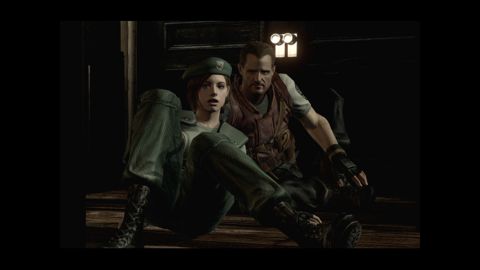
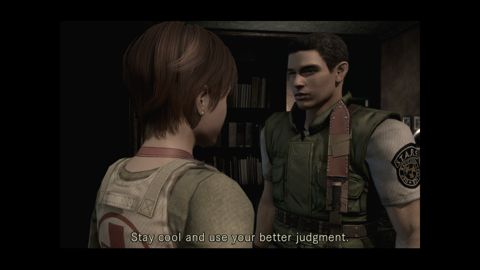
There are two playable characters to pick from at the start, Jill Valentine or Chris Redfield. Canonical story events are a mix of both, so neither matters in terms of the ‘real’ story.
Playing as Jill has always been recognized as the Easier Mode. This is true, unless you plan to take lots of damage. Since her health is much lower, two or three zombie bites will render her ghoul food. She makes up for this in two significant ways, however. First, she gets two extra inventory slots compared to Chris, which is actually a big deal. Second, she carries a lockpick, enabling her to open important early game doors much faster.
Chris has more health, but the advantages end there. The fewer inventory slots bog him down with item management and constant trips back to the universal magic item box. Without his own lockpick, he has to locate and collect “Old Keys” to open those doors, which is a pain when inventory spaces are already so few.
In addition, there are a few surprises in the Chris campaign. Zombies will break through doors and repopulate hallways the player cleared before. The best way to balance a character having higher health is throwing more monsters at him. He has to deal with a scarier, less predictable mansion than over in Jill’s game.
Chris has a default Lighter in lieu of the lockpick. Now in the original game, you didn’t need the Lighter for much. Here, it’s an essential survival tool. After the player shoots down a zombie, it remains in the same spot where it fell. After an in-game timer hits zero, that zombie rises again as a Crimson Head: stronger, meaner, faster, and redder. Crimson Heads make any needed backtracking much tougher to deal with.
Crimson Heads are a new addition to RE1 survival horror. Aside from cranial obliteration, preventing a Crimson Head problem is burning the zombie to a crisp in the first place. But like health items and ammo, you can only refill your kerosene flask so many times before there’s no more left to use. Thus, it also involves strategic planning. You have to decide which rooms or hallways will have the most foot traffic, and remove the zombies from those specific areas. The mansion is big enough that most areas connect together, so a player who knows the map well can circumnavigate danger to save resources.
Crimson Heads aren’t the only new danger creeping around the Spencer Mansion. Later we’ll run into Lisa Trevor, a mutated, invincible relic with superhuman strength. Reading the files that piece together her tragic backstory has the same emotional weight as meeting her…wearing all the sewn-together faces she’s collected, wrecking your health with the manacles that still bind her wrists. Every encounter with Lisa is engineered to be unsettling.
And the entire house itself is unsettling. What makes REMake so timeless is how every room, corridor, and outdoor area bleeds atmosphere. Playing it in the dark carries the risk of feeling like you’re being watched, or something’s breathing on your neck. This is what we used to claim about the original Resident Evil, until we either played it too much or it started looking too primitive.
What amazes me is that REMake began as a Nintendo GameCube game, and we are now so many years past the sixth console generation that it feels like a distant memory. Regardless, REMake still looks that good. Years from now, when we’re either all extinct or playing in Holodecks, I still expect that it will still look good.
And after all these years, I’ve come to rethink the whole bad acting thing. Oh, I still don’t think the original had good acting, at all. That’s not what I’m saying. But it took a few series entries for me to realize there’s an aspect of RE that doesn’t take itself serious. Even though the original's PlayStation jewel case had eleven blurbs about FEAR and SCARING YOU, the game was glazed in B or even Z movie horror. So, yes, that awful voice acting might’ve been on purpose.
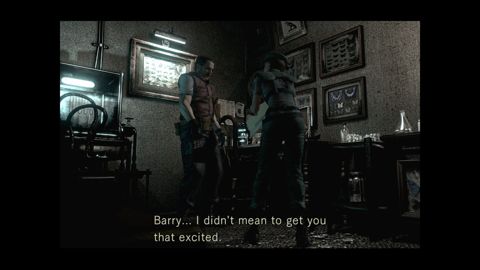
REMake focuses more on being scary. It can still be silly in parts. For instance, they kept that bit where Barry expresses his love for his Magnum, albeit in a less outlandish manner. The whole Jill Sandwich thing? Again, less ridiculous, but in there. Master of Unlocking, not so much. But like RE4Make, it’s about the horror, the uneasiness of entering a new area and not knowing if the fixed camera hides a threat. It’s about making it clear the mansion is a terrible place to spend the night in.
But REMake is wonderful, remarkable not just for being a stellar remake, but a landmark video game release. It takes everything that still holds up about ‘96 RE and makes into a monster with maximum replayability. If you’ve never played Resident Evil before, my advice is to start with the PlayStation original, and then switch over to this for any future replays. REMake is the best possible Resident Evil, impactful enough to make me shut up and enjoy it.
Final Rating: ****