Planes, Trains, and Automobiles (1987)
True Bromance.
Although there are thousands of Christmas movies. I can’t think of many Thanksgiving films other than Planes, Trains, and Automobiles. I watched Pieces of April once. I’m also aware of some Eli Roth movie about Black Friday crushing deaths and being cooked alive and shit. Look, there will still be resentment around the dinner table this year over politics. Do we need murder burning the turkey even worse?
Anyway, this finalized review arose from handwriting I scribbled in a notebook over a year ago. I had a lot to say about Planes, Trains, and Automobiles. My draft highlighted every important plot point for a reading audience, like I was eight years old again and explaining Link to the Past to my bored parents.
This happens with my reviewing sometimes, and there are a couple reasons why. Either the movie is so bad that I’m riffing it scene-by-scene while trying to be funny, or it’s significant in a positive way. Planes, Trains, and Automobiles is significant. It’s a movie you can throw on as background noise to pick up on the general idea: two men forced together on a road trip, Murphy’s Law haunting them every mile. But absorbing the impact requires closer attention.
The two men are Neal Page (Steve Martin) and Del Griffith (John Candy). Neal is a workaholic advertising executive, married, and father of three. It’s two days before Thanksgiving, and he needs to to get home from New York to Chicago after a business trip.
Though Neal is scheduled to be back before midnight, the Murphy’s Law kicks in right at the outset. He’s late for his flight. He loses a taxi cab to Kevin Bacon, loses another cab after bribing an evil lawyer. By the time he reaches the airport, he is already bitter.
Then his flight is delayed. And it’s right here Neal meets Del. Del is Neal’s mirror opposite, an extroverted shower curtain ring salesman who talks nonstop and radiates so much politeness and optimism that it’s blinding. We already know Neal is a powder keg, his frustration seething beneath the surface at any given moment. That means Del, who talks, and questions, and jokes, and laughs, whose body mass dominates every space, is the wrong person to be too close to Neal. One can also predict, from a lifetime of watching movies, that Del will always end up too close to Neal.
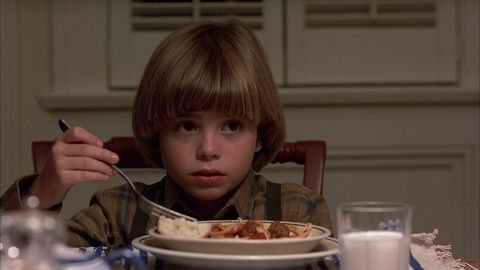
Meanwhile, Neal’s wife and children await his return. He lives in one of those John Hughes palaces across from the Uncle Buck and Home Alone houses. His wife, Susan, is played by Laila Robins, and one of the kids is Matthew Lawrence, of Mrs. Doubtfire and Boy Meets World fame.
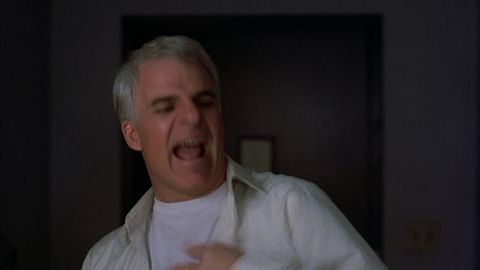
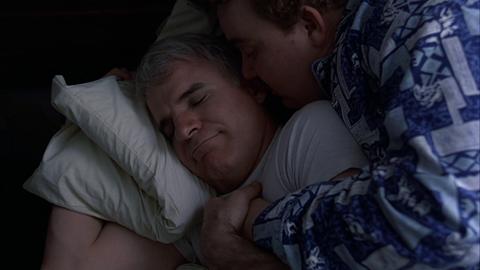
A snowstorm forces Neal’s plane to land in Kansas instead of Illinois. As a quick reminder, that’s two states over to the left. Soon Del and Neal share a cab ride, and then a motel room. With a single bed. Then Neal can no longer pretend to tolerate Del’s bad habits, the proto-Buck Russell smoking and spilling beer on the sheets, and the sinus clearing noises and too much talking and the having to sleep beside a male stranger, and he blows up.
This scene is important. So many of them in this movie are, but God knows, there’s a lot happening here. Neal’s rant encompasses all the comedic elements Steve Martin is renowned for, the boundless energy and the emotional pinwheeling. But it’s gut-wrenching to watch as Del takes the verbal abuse head-on, tears welling in his eyes. His determined, pained response crushes Neal with guilt.
We, the audience, know as much about Del at this point as Neal. And it’s easy to presume the barbs he throws out during his tirade, that Del is an obnoxious fat leech whose role here is to do the Chris Farley routine. But like Neal, we’re about to spend a lot more time with Del, and we’re about to learn.
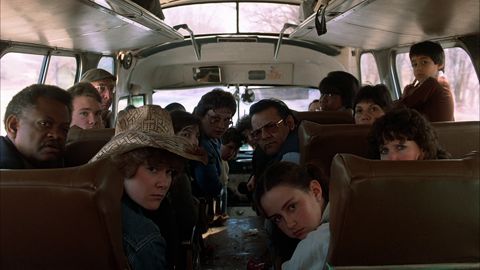
Because the next morning, the two discover a thief stole their cash. As they credit charge their way back to Chicago, more disasters occur. No matter how much Neal tries to distance himself, fate has chosen Del as his accidental stalker, or vice-versa.
Neal buckles under the pressure. He’s pushed to his limits, and the limit ceiling raises. But then something else happens to him. He acts nicer. Smiles. Laughs. Responds with less bitterness. Talks to strangers. He treats Del more as an equal, less as a hindrance.
By the time Planes, Trains, and Automobiles reaches its Automobiles act, the two are an Odd Couple sharing a crappy rental car. But in the span of a 90-minute runtime, their friendship stays on the slowest cooking setting. Tension remains even as they enjoy each other’s company more. Ultimately, it comes down to unstoppable force versus immovable object, a reserved and quiet man overlapping with a loud one. A workaholic who takes everything for granted is stuck with someone who, at his core, is in desperate need of a friend.
The movie was written and directed by the late John Hughes, marking a shift in his subject matter from teenagers to grownups. Coming off his Brat Pack era here, he accomplishes the same feat that made his young people in the likes of Sixteen Candlesand Pretty in Pink so renowned. He treats his characters like real people. Flawed as they are, he asks us to look closer at them. It would be easy to make Neal and Del into cartoon characters, and though there are moments where they act cartoonish, it's within relatable human boundaries.
Planes, Trains, and Automobiles runs for an hour and a half, but the studio edited it down from a 4-hour cut now lost to time. It featured several more scenes of Neal’s family, with Susan convinced that Neal must be cheating on her. The editing recenters the entire movie around the road trip, and thank God for that. I couldn’t think of a worse pacing killer. The journey, and the goal, are what’s important. Wonderful as it is already, Planes, Trains and Automobiles didn't need to be Gone With the Wind.
Planes, Trains and Automobiles is Thanksgiving turkey cooked right. It’s a relatable achievement that also has an underlying sweetness, especially if you are rewatching it after knowing the ending (which I won’t spoil.) It deserves a place in anyone’s holiday movie rotation.
Final Rating: ****